

The DIFC offers a DFSA-regulated financial-services framework and an innovation-testing route for qualifying fintech concepts. For fintech regulatory licensing in the UAE, the right setup depends on what the product does and which rules apply. The DFSA has stated that it does not regulate cryptoasset product offerings or license firms undertaking those activities in the DIFC.
It is reasonable to weigh the DIFC’s business environment against the cost and demands of authorisation. This guide explains what the DIFC can offer, how it compares with ADGM and mainland UAE, and what to understand about DFSA fees before planning a launch.
You will also find an overview of ADGM FSRA rules for virtual assets and digital securities, including how its assessment considers governance, resources and controls. Together, these points help you map the proposed activity to the right regulatory route before committing to a setup.
Key Takeaways
- Match each product activity to the regulator and jurisdiction that governs it before choosing where to establish.
- For an ADGM application, prepare a regulatory plan that sets out proposed activities, controls, resources and risk management.
- Compare DIFC, ADGM and mainland routes by authorisation scope, capital requirements and whether the model can operate across jurisdictions.
- Assess DFSA application and annual fees alongside the wider setup requirements, rather than treating the licence fee as the full cost.
- For virtual assets and digital securities, distinguish the relevant regulatory framework from the choice of business location.
FSRA virtual asset and digital securities rules in the ADGM
For open finance, crowdfunding and digital banks, map the service activities and customer flows before selecting a licence. Stored value applicants must be incorporated onshore or in a free zone, not the DIFC or ADGM. UAE BNPL providers must apply for a (Restricted) Finance Companies licence.
For virtual assets, the regulator depends on where the business operates and what it does. ADGM’s FSRA assesses the proposed activity, governance, systems, controls and resources, while Dubai’s VARA oversees specified virtual-asset activities.
Virtual Asset and Cryptocurrency Licensing
In Dubai, VARA’s activity scope includes advisory, broker-dealer, custody, exchange, lending and borrowing, management and investment, transfer and settlement, and Category 1 issuance. In ADGM, financial services activities require prior FSRA permission. Map each service separately, since an exchange, custody function and token issuance can involve different regulatory considerations.
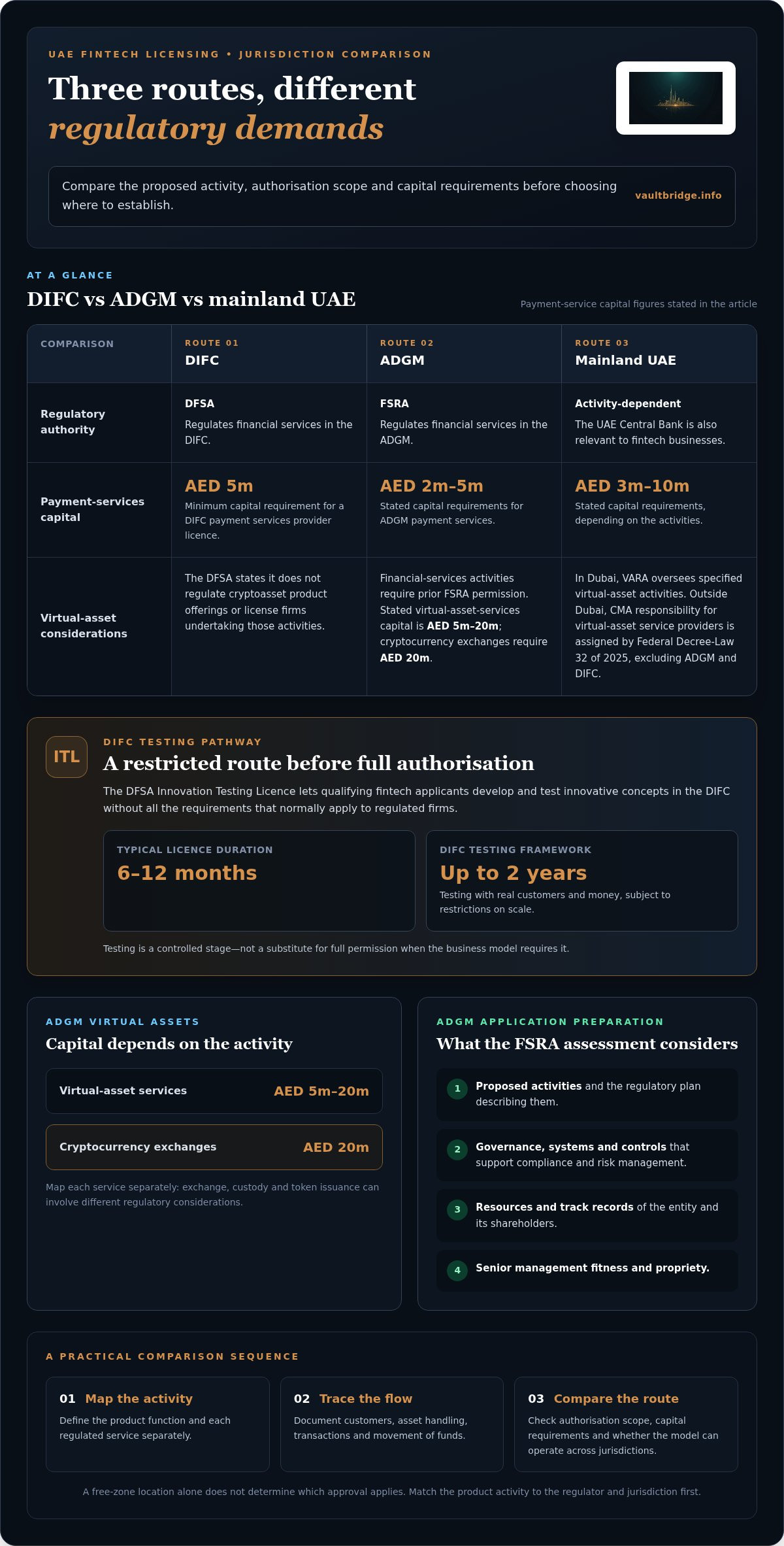
ADGM states capital requirements of AED 5 million to AED 20 million for virtual asset services, with AED 20 million for cryptocurrency exchanges. These figures make the proposed activity a practical part of early structuring. Outside Dubai, CMA responsibility for virtual asset service providers is assigned by Federal Decree-Law 32 of 2025, excluding the ADGM and DIFC.
Digital Asset Regulatory Frameworks
The ADGM FSRA issued guidance on conducting cryptoasset activities in June 2018. In February 2020, it issued further guidelines amending its guidance on crypto assets, ICOs and digital securities. These documents help applicants distinguish the token or asset structure from the regulated service performed around it.
Before an initial discussion with the FSRA Authorisation Team, prepare a regulatory plan describing the proposed activities, internal controls and resources for managing related risks. The assessment considers whether systems and controls support governance and compliance, as well as the entity’s and shareholders’ operational, financial and regulatory track records. Senior management fitness and propriety also matter.
Digital securities require careful activity mapping: identify the rights attached to the asset, how it is offered, and which services the firm will provide. ADGM’s main financial services and fintech regulatory framework is the Financial Services and Markets Regulations 2015, as amended. In the DIFC, updated crypto token regulations became effective on 12 January 2026, while the DFSA states it does not regulate cryptoasset product offerings or license firms undertaking those activities.
Across the UAE, labels such as “crypto,” “digital bank” or “open finance” do not determine the regulatory route. Document the product’s function, customer relationship, asset handling and transaction flow, then match those features to the relevant jurisdiction’s framework. For fintech regulatory licensing in the UAE, this activity-first map helps distinguish where a product is tested, issued, held or transferred.
Why setup a financial services firm in the DIFC?
The DIFC combines a dedicated financial-services environment with authorisation by the Dubai Financial Services Authority (DFSA). Its Innovation Testing License offers qualifying fintech applicants a restricted route to develop and test concepts before pursuing full authorisation.
For UAE payment service providers, stated capital requirements range from AED 3 million to AED 10 million on the mainland, depending on activities. ADGM payment services have stated capital requirements of AED 2 million to AED 5 million, while a DIFC payment services provider license has a minimum capital requirement of AED 5 million. A payment aggregator should map its actual payment functions to the relevant licensing category and regulator.
The regulatory authority depends on the establishment and activity. The DFSA regulates the DIFC, while the ADGM is regulated by the Financial Services Regulatory Authority (FSRA). The UAE Central Bank is also relevant to fintech businesses. A free-zone location alone does not determine which approval applies: define the service, customer journey and movement of funds first.
The DFSA Innovation Testing License is a restricted financial-services licence for qualifying applicants. It allows innovative concepts to be developed and tested in the DIFC without all the requirements that normally apply to regulated firms. A typical licence lasts six to twelve months. The DIFC testing framework also allows fintech companies to test products with real customers and money for up to two years, subject to restrictions on scale.
Use the testing period to build evidence for a full-authorisation plan. Document product conduct, governance, customer protections, risk controls and the resources required for commercial operations. The DFSA then assesses whether the proposed firm can meet the requirements attached to its regulated activities. Testing is a controlled stage, not a substitute for full permission when the business model requires it.
Banking access needs its own operational workstream. An authorisation plan should explain expected account use, payment flows, customer funds and reconciliation controls. This gives the firm a clear basis for engaging with banking counterparties, while keeping bank readiness distinct from DFSA permission. Build both workstreams into the launch sequence instead of treating a licence as automatic access to banking.
For founders, the DIFC route can align product testing, governance design and authorisation planning in one financial centre. The appropriate route still depends on the activity: payment services, investment functions and digital-asset offerings do not share a single licence. Map each function, then structure the application around its actual scope. DIFC licensing preparation can help turn that activity map into a launch plan.
DIFC, ADGM and mainland jurisdiction comparisons
Choose the jurisdiction by mapping each regulated activity, customer group and operating model to its governing authority. DIFC and ADGM have separate financial regulators, while mainland licensing routes depend on the activity and relevant UAE authority.
Jurisdiction and Regulatory Approach Comparisons
The DIFC falls under the Dubai Financial Services Authority (DFSA), while the Abu Dhabi Global Market (ADGM) falls under the Financial Services Regulatory Authority (FSRA). Mainland UAE fintech activities may involve the Central Bank or, for virtual asset service providers outside Dubai, the CMA under Federal Decree-Law 32 of 2025. That law excludes the ADGM and DIFC from the CMA allocation.
Capital requirements show why activity mapping matters. ADGM payment services have stated capital requirements of AED 2 million to AED 5 million. Mainland payment service providers face AED 3 million to AED 10 million, depending on their activities. Mainland e-money and digital-wallet businesses may be subject to capital and guarantee requirements.
ADGM’s main financial services and fintech regulatory framework is the Financial Services and Markets Regulations 2015, as amended. Financial services activities in or out of ADGM require prior FSRA permission. Compare the actual regulated functions, rather than treating a free-zone company registration as financial-services authorisation. The jurisdiction should fit the activity, customer protection needs and intended operating footprint.
Licences do not passport across the UAE jurisdictions discussed here. A fintech authorised in one jurisdiction needs additional licensing to conduct activities in another. Build separate regulatory approvals into expansion plans, including where customers, transactions and services cross jurisdictional boundaries.
ADGM Fintech Ecosystem and RegLab
ADGM’s RegLab is a sandbox for startups and existing regulated companies testing eligible fintech innovations. Participants must present an innovative technological solution that is ready for testing, outside current regulated activities, and contributes to UAE financial-sector development. The RegLab allows participants to test without the full suite of traditional financial-services requirements at the outset.
An ADGM RegLab licence is typically valid for two years. Stated capital requirements range from AED 100,000 to AED 500,000. After a successful trial, participants may migrate to a full licence if their innovation is ready for commercial launch. Otherwise, they must cease activities in ADGM and exit the RegLab.
Use the RegLab when a test can establish whether a defined innovation works before full commercial authorisation. Prepare the operating model, testing scope and transition plan together. For a conventional regulated service, the FSRA permission process remains the relevant route. A sandbox is not a substitute for required authorisation.
DFSA application and annual licensing fees
DFSA fees are one part of the DIFC authorisation budget, alongside the work needed to establish an operating firm. Separate application planning from annual obligations and wider commercial setup requirements.
To obtain a Central Bank of the UAE (CBUAE) licence, first define the financial service and identify the applicable licensing category. Prepare the application around that activity, then allow time for regulatory assessment. UAE fintech companies commonly take 6 to 12 months to obtain licensing and launch.
Application Fees and Licensing Costs
These source figures are stated in US dollars, so they are not presented as AED amounts here. Treat the application charge and recurring annual fee as separate budget lines.
For planning, map the requested regulated activities and resulting licence scope before estimating the total setup budget. A DFSA fee is not the same as the broader cost of establishing a corporate presence or preparing the firm to operate. Keep each cost category distinct in internal forecasts.
Application Information and Assessment
Structure the application around the proposed service, the firm’s operating model and the controls supporting it. Explain how governance, compliance and risk management work together. A clear connection between the activity and the firm’s systems makes the application easier to assess.
For ADGM applicants, FSRA assessment considers the entity’s and shareholders’ operational, financial and regulatory track records, as well as senior management fitness and propriety. These criteria are useful planning prompts for any fintech leadership team preparing regulatory materials, even though the authority and application route differ.
Timelines depend on the authorisation route and how clearly the application defines its activities and controls. UAE fintech companies commonly take 6 to 12 months to obtain licensing and launch. Build this period into commercial planning, with time allocated for application preparation, regulator assessment and readiness to operate.
Keep the Commercial Licence process distinct from financial-services permission. In ADGM, an applicant that accepts in-principle approval conditions must satisfy them, prepare for capitalisation and hiring, then contact the ADGM Registration Authority to begin its Commercial Licence application. ADGM issues the Financial Services Permission after the approval conditions are met.
For a DIFC application, organise the work into a controlled sequence: define the regulated activity, prepare the application information, account for DFSA application and annual fees, then plan the firm’s commercial setup. This helps leadership teams connect regulatory scope with operational readiness, rather than treating authorisation as a standalone filing.
DIFC’s regulatory framework and business advantages
DIFC Law 1 of 2004, as amended, anchors financial-services regulation in the centre. Compliance planning must also account for the product, customer activity and required authorisation.
UAE fintechs must implement AML/KYC procedures, including customer due diligence, transaction monitoring and suspicious-activity reporting; data protection requirements include Federal Decree-Law 45 of 2021. Conducting regulated financial services without prior permission breaches the applicable authorisation requirement and can expose the business to regulatory action.
Licensing Costs and Capital Requirements
Capital depends on the licence and activity. DIFC Innovation Testing License capital requirements are typically AED 500,000 to AED 2 million. A DIFC payment services provider license has a stated minimum capital requirement of AED 5 million; DIFC digital asset services have stated capital requirements of AED 10 million to AED 50 million, depending on activities.
These amounts describe capital requirements, not the full cost of establishment. Separate regulatory capital from commercial setup costs and ongoing operating resources. For a non-regulated startup, the DIFC Innovation License is distinct from DFSA authorisation: it addresses a different setup route and does not grant permission for regulated financial services.
The DIFC framework also supports fintech innovation through the DIFC FinTech Hive accelerator. Treat accelerator participation as distinct from regulatory approval. Map the proposed business model first, then determine whether it requires a DFSA-regulated permission or a non-regulated startup setup.
Fintech Compliance and Unlicensed Business Risks
Build compliance controls into the operating model, not as a final filing step. UAE fintech firms must implement customer due diligence, transaction monitoring and suspicious-activity reporting under AML/KYC procedures. The UAE Personal Data Protection Law is Federal Decree-Law 45 of 2021. Cybersecurity controls should protect systems, access and customer information as part of the firm’s risk framework.
For crypto, distinguish token products from financial services performed around them. The DFSA states it does not regulate cryptoasset product offerings or license firms undertaking those activities in the DIFC. Updated DIFC crypto token regulations became effective on 12 January 2026. Identify the activity and applicable framework before launch.
Operating without required permission creates direct regulatory exposure. According to the ADGM FSRA, financial-services activities in or out of ADGM require prior permission. The practical risk goes beyond an incomplete application: a business may need to stop activities that lack authorisation and address gaps in governance, customer protection and controls before proceeding.
For leadership teams, the sequence is clear: classify each product activity, determine the required permission, then align capital and compliance controls with that scope. This keeps innovation, advisory and commercial plans anchored to the relevant DIFC framework.
Vaultbridge: License marketing launching tokenizing
Vaultbridge helps UAE founders and enterprises structure licensing, tokenization, project launches and marketing around their fintech model. Turn to the firm once you have mapped your proposed activities and need to align the regulatory route with how the product will operate.
That work can connect licensing strategy with asset tokenization and a compliant Web3 or fintech rollout tailored to regional legal standards. Clear activity mapping helps frame the application and launch plan around the relevant UAE authority, business model and product flows.
For a project moving from concept toward launch, coordinate the licensing approach, token structure and market introduction as connected workstreams. Visit vaultbridge.info to discuss your UAE fintech project with Vaultbridge.
Turn your regulatory plan into an operating roadmap
The next step is to make regulatory decisions usable across the business. Set clear internal decision points for product design, market entry and future changes. That roadmap helps leadership keep commercial priorities aligned with the chosen operating model as the venture develops.
A well-structured fintech regulatory licensing strategy in the UAE connects the licence pathway with the product’s intended use, customer journey and launch sequence. Treat those elements as one system, not separate workstreams. This gives teams a practical reference for evaluating changes before they affect operations or market plans.
Vaultbridge supports licensing, tokenization, project launches and marketing for UAE fintech ventures. If you’re preparing to move from regulatory planning into execution, contact Vaultbridge about your UAE fintech plans. A considered next step can help you build momentum with a clearer direction and a stronger foundation for growth.
Frequently Asked Questions
Which UAE regulators oversee fintech licensing: CBUAE, SCA, DFSA, FSRA, and VARA?
The regulator depends on the activity and jurisdiction. The Central Bank of the UAE oversees relevant payment and stored-value activities; the DFSA regulates financial services in the DIFC, and the FSRA regulates them in ADGM. VARA oversees specified virtual-asset activities in Dubai. For securities and virtual-asset services elsewhere, the responsible authority can differ, including the SCA or CMA. Map the service and location together before selecting the application route.
What fintech activities require a licence or regulatory approval in the UAE?
Activities involving payments, stored value, lending, securities or virtual assets can require licensing or regulatory approval. For example, digital remittance providers may need a Retail Payment Services and Card Schemes or Exchange House Category IV licence. UAE BNPL providers must apply for a (Restricted) Finance Companies licence. Large Value Payment Systems require prior Central Bank licensing. The applicable route depends on what the business actually does, not its technology label.
What are the minimum capital requirements and application fees for UAE fintech licences?
Capital varies by jurisdiction and licensed activity. Capital requirements for mainland payment and e-money services vary according to the activity and regulatory route. ADGM payment services require AED 2 million to AED 5 million; DIFC payment services have a stated minimum of AED 5 million. Application and annual fees are separate charges, and the applicable fee depends on the regulator and permission sought.
How do fintech licensing rules differ between mainland UAE, DIFC, and ADGM?
Mainland firms apply through the relevant federal or emirate-level regulatory route, while the DIFC and ADGM have their own financial regulators, the DFSA and FSRA. That distinction affects the permission process, regulatory framework and capital requirements. A licence in one of these jurisdictions does not passport across the others. A firm expanding into another jurisdiction must map its activities there and obtain any additional required authorisation.
What licences are required for digital assets, crypto exchanges, and virtual asset services in the UAE?
The required permission depends on the service and operating jurisdiction. In Dubai, VARA oversees activities including exchange, custody, broker-dealer and transfer services. ADGM virtual-asset businesses apply through the FSRA framework; stated capital requirements range from AED 5 million to AED 20 million, with AED 20 million for cryptocurrency exchanges. Outside Dubai, CMA responsibility for virtual-asset service providers is assigned by Federal Decree-Law 32 of 2025, excluding DIFC and ADGM.